Public Sector
Surrey District Council: Solar Carport and Battery Storage Study
Client: District Council in Surrey
The Challenge
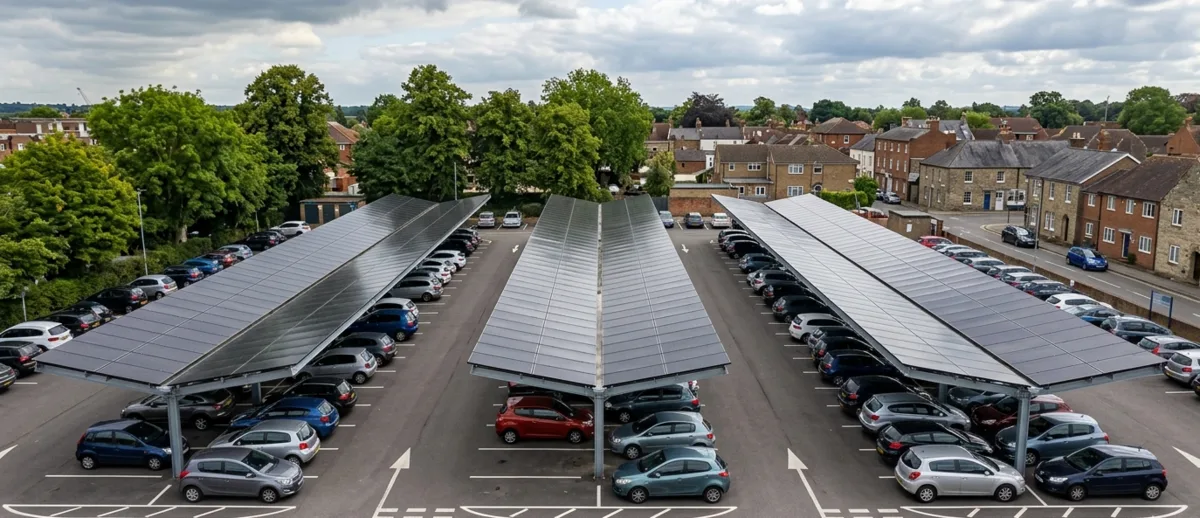
The council owned six car parks across two towns. All had EV charging already in place with a third-party provider, and a small rooftop solar system installed on one of the adjacent council buildings. The question was whether solar carports and battery storage could cut electricity costs, support carbon targets and put underused space to good use.
The sites were split neatly in half. Three had large council owned buildings beside the car parks, with half-hourly metered supplies and year-round demand. The other three were remote car parks running little more than lighting and CCTV. Same technology brief, two very different commercial challenges.
Our Approach
Tipio Energy delivered a portfolio-wide feasibility study covering carport design, battery sizing, EV charging analysis and financial modelling for all six sites. We completed preliminary designs which laid out the solar carports for each car park using 550Wp bifacial solar modules and sized to the maximum available footprint. Hourly generation was matched to half-hourly consumption to calculate self-consumption, export volumes and avoided grid costs. At the three on-site demand sites, we modelled battery storage scenarios from 100kWh to 500kWh to test the value of shifting daytime generation into the evening. Every option was modelled over 30 years using HM Treasury Green Book methodology at a 3.5% real discount rate (the standard appraisal framework councils use to compare long-term capital investments), so the council had a full 30-year financial picture for each scenario. The three remote sites needed a different approach. With no behind-the-meter demand to drive the economics, we assessed them under a fixed-rate export PPA model and identified further commercial options the council may want to explore as a separate piece of work. All financials were presented as unlevered (before any borrowing costs), leaving the council's finance team free to apply their own borrowing assumptions. Sensitivities covered electricity prices, battery degradation and export tariffs. The final report included a constraints and opportunities register for each site, covering planning, structural, grid connection and operational risks.
The Outcome
Solar carports worked technically at all six sites, with a combined capacity of 1,782kWp and around 1,575MWh of generation a year.
At the demand sites, self-consumption ranged from 44% to 93% depending on the building's load profile. Battery storage lifted that by 10 to 25 percentage points, though oversizing eroded returns quickly. The strongest case was at the highest-consumption site, where solar alone returned a nine-year payback and a 30-year NPV (the project's lifetime value in today's money) above £500,000.
The remote sites needed more thought. Under a basic Smart Export Guarantee tariff at around 5p/kWh, the case was marginal. Modelled under a fixed-rate export PPA at 10p/kWh, all three sites returned positive but modest results, with payback periods of 17 years and IRRs around 4.6% to 4.9%. The more promising opportunities sit in commercial structures we did not model in this commission. Sleeved PPAs matching generation to the council's own demand sites, and reconnecting the existing EV chargers behind the solar carport supply, are the next logical steps for those sites.
Across the portfolio, the carports would avoid roughly 308 tonnes of CO₂e a year in year one, with that figure declining as the grid decarbonises. The council now has the evidence base to prioritise sites, secure capital and move to procurement.