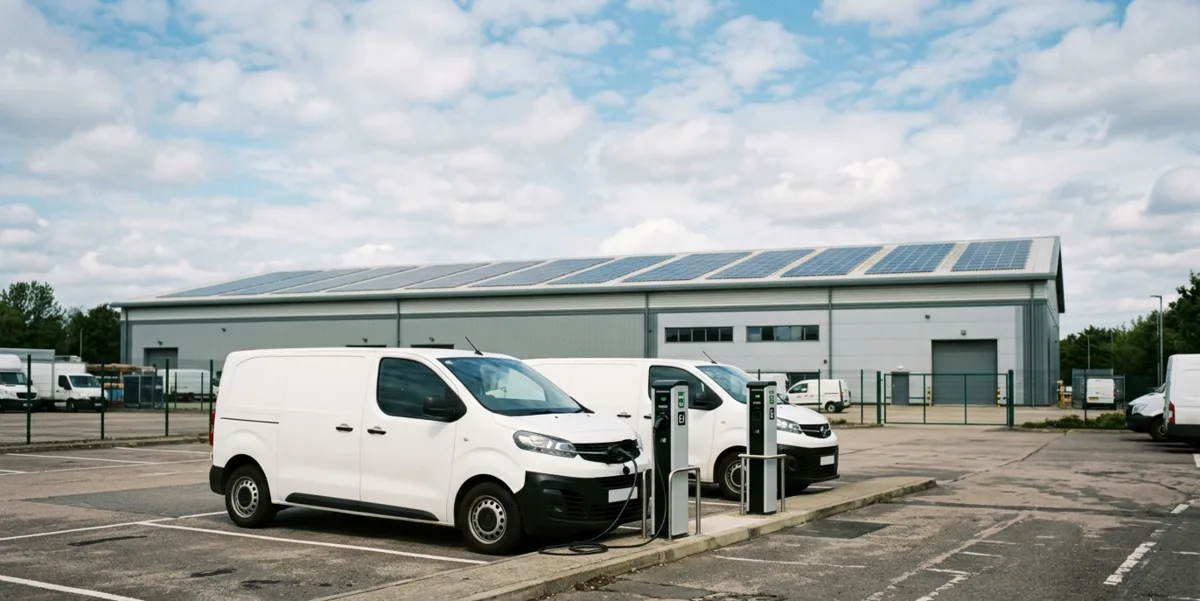
Electric Fleets Need More Than Chargers. They Need an Energy Strategy.
Most fleet operators planning depot-level EV charging already know that grid capacity is the constraint. Connection queues are long, reinforcement costs are high, and DNO lead times can stretch a transition programme by a year or more. We covered that challenge and the DNO engagement process in a recent article. This one picks up the next question: once you know what your grid position allows, how do you design an energy system that makes fleet electrification work within those limits?
The short answer is that chargers alone will not get you there. When 30 or 40 electric vans need to charge between shifts, the power demand at a single depot can spike to several times its historic peak. Smart charging helps, but at many sites it is not enough. Solar generation and battery storage, designed as a coordinated system around your actual depot operations, can cap those peaks, defer costly grid upgrades and bring a chunk of your energy spend onto a more predictable footing.
What Solar-Plus-Storage Actually Does at a Depot
Solar and battery storage are not a magic fix for grid constraints. But when designed around real depot operations rather than generic assumptions, they address three specific problems that matter to the people signing off on fleet investment.
Caps peak demand and reduces demand charges
The primary value of depot batteries is in flattening the spikes caused by multiple vehicles charging simultaneously. A battery charges from the grid at lower power over longer periods, typically overnight on cheaper tariffs, and discharges during the fleet's charging window. This reduces the site's metered maximum demand, which directly cuts demand charges. For depots where EV load would otherwise push total demand above the agreed site capacity, this can be the difference between needing an expensive grid upgrade now or not.
Defers or avoids grid reinforcement costs
Battery storage limits instantaneous grid import while serving the higher momentary load of multiple chargers from stored energy. Real projects in the UK and Europe have shown microgrids using solar and multi-hundred-kWh batteries to run dozens of 22kW chargers behind a constrained connection, enabling fleet growth without immediate reinforcement. In some locations this is a bridge until grid upgrades arrive. In others it becomes the long-term architecture because it supports further capacity at lower cost than a reinforced connection.
Improves cost predictability
Batteries can arbitrage between time-of-use tariff periods: buying energy overnight at 10p to 15p per kWh and discharging it during peak windows when prices hit 28p to 38p per kWh. That alone reduces exposure to the volatile wholesale-driven charges that have characterised recent UK energy markets. When you add solar into the mix, on-site generation hedges a portion of future energy costs by locking in the levelised cost of electricity for that share of consumption. For a depot running large refrigeration or processing loads alongside chargers, this predictability matters beyond just the fleet.
Start with Data, Not Hardware
From our experience, the most common mistake in depot energy design is starting with a hardware specification. Someone gets a quote for a battery or a set of chargers and works backwards to justify it. The result is usually an oversized system, an undersized one, or kit that does not talk to anything else on site.
The right starting point is data. At minimum, you need half-hourly site metering data for at least 12 months including peak demand values, a detailed inventory of existing large loads such as refrigeration and compressed air, planned fleet composition with battery sizes and typical daily energy requirements per route, and parking and charging patterns showing which vehicles have long dwell times and which need rapid turnarounds.
These inputs allow you to build baseline and with-EVs load profiles, showing how total demand changes by time of day and what fraction of EV charging could realistically be shifted within the operating day. Early analysis often reveals that smart charging alone removes part of the apparent peak by staggering sessions within existing windows, before any solar or storage is considered. For smaller fleets with ample grid capacity and long overnight dwell times, smart charging under a competitive time-of-use tariff may be sufficient. Storage and solar are then sized only where the data shows a genuine commercial case.
Sizing and Phasing: Getting It Right
Solar PV at depots is usually constrained by available roof and canopy area before it is limited by annual energy demand. The aim is high self-consumption: typically 70% or more of generation used on site, because exported energy earns far less than offsetting retail tariffs. Transport and logistics depots, with extended operating hours and large base loads, often achieve this even with sizeable rooftop systems.
Battery sizing should be driven by the peak you need to shave, not by the largest system a vendor will quote you. Power capacity in kilowatts is typically sized as a fraction of the incremental EV-driven peak, while energy capacity in kilowatt-hours is determined by how long that reduction must be sustained. Studies of behind-the-meter storage for fast charging show that relatively modest energy capacities can deliver strong returns where demand charges are high and charging peaks are short but intense.
Control matters as much as sizing. At the simplest level, a depot battery follows a fixed charge and discharge schedule aligned with tariff windows and typical charging periods. More advanced deployments use energy management systems that take live data on charger usage, fleet schedules, solar production, prices and grid signals to make real-time dispatch decisions. The key requirement is that chargers, batteries and solar inverters should operate under a unified control strategy using a common communications protocol. Systems that cannot communicate are the most common cause of underperformance in real depot deployments.
Not every depot needs batteries on day one. The most successful programmes we see are phased. Initial stages focus on solar and smart AC charging. Storage is added when grid constraints or demand charges justify it. DC capacity comes later as heavier vehicles electrify. Designing with this trajectory in mind avoids stranded assets and lets lessons from early phases inform later decisions.
When Solar-Plus-Storage Is Not the Answer
Solar and batteries do not make sense everywhere, and saying so is part of giving honest advice.
If you are running a small fleet with long overnight dwell times and your grid connection has headroom, basic smart charging under a competitive tariff may be all you need. If your site has unconstrained, low-cost grid capacity and modest demand charges, the cost and complexity of storage may not be justified. Buildings with limited suitable roof or yard area for solar cannot stack the combined benefits that make the economics work. And organisations without the appetite or capability to engage with a more complex energy system may find the operational overhead outweighs the financial gain.
Recognising these boundaries matters. Capital should go where it delivers genuine commercial and operational value, not into kit that looks good on a sustainability report but does not earn its keep.
How Tipio Energy Approaches This
We start with your data, not with a pre-set answer. We analyse your half-hourly consumption, your fleet duty cycles, your tariff history and your grid connection to see where solar-plus-storage genuinely earns its keep at your depot, and where it does not.
We then model a specific scenario for your site: system sizing, projected savings from demand charge reduction, arbitrage potential under your tariff, deferral of reinforcement costs, and how the numbers change under different ownership structures. We show you the modelled payback period, the IRR, and what portion of your energy spend moves to a more predictable footing if you proceed.
Because we are independent, we have no ties to battery suppliers, charger manufacturers, installers or finance providers. That means we can benchmark different configurations, compare ownership against funded models side by side, and flag where assumptions feel optimistic or where contract terms sit outside current market practice. We present findings in a way that works for your board, your finance team or your estates committee: clear numbers, clear risks, and a business case you can interrogate.
Get a site assessment and see how solar-plus-storage could support your fleet electrification.
More Insights
The Consumption Baseline: Why Half-Hourly Data Should Come Before Capital
Most businesses make energy investment decisions off a monthly bill, before anyone reads the half-hourly data the meter already produces. That data shows which technology fits the site, where cost can be reduced now, and what a defensible investment case needs.
The Depot Charging Scheme: what £170m of UK funding will, and won't, pay for.
The Depot Charging Scheme has £170 million for UK fleet depots. The grant covers 70% of chargepoint and civils costs but not the grid connection, the vehicles, planning or design. Window two opens 28 October 2026.
Solar on Leased Buildings: What Landlords and Tenants Need to Get Right
Around 55% of UK commercial property by value is rented rather than owner-occupied. Solar on those buildings now works technically and commercially. What determines whether a project delivers is the lease, the funding route and the property structure underneath the panels.