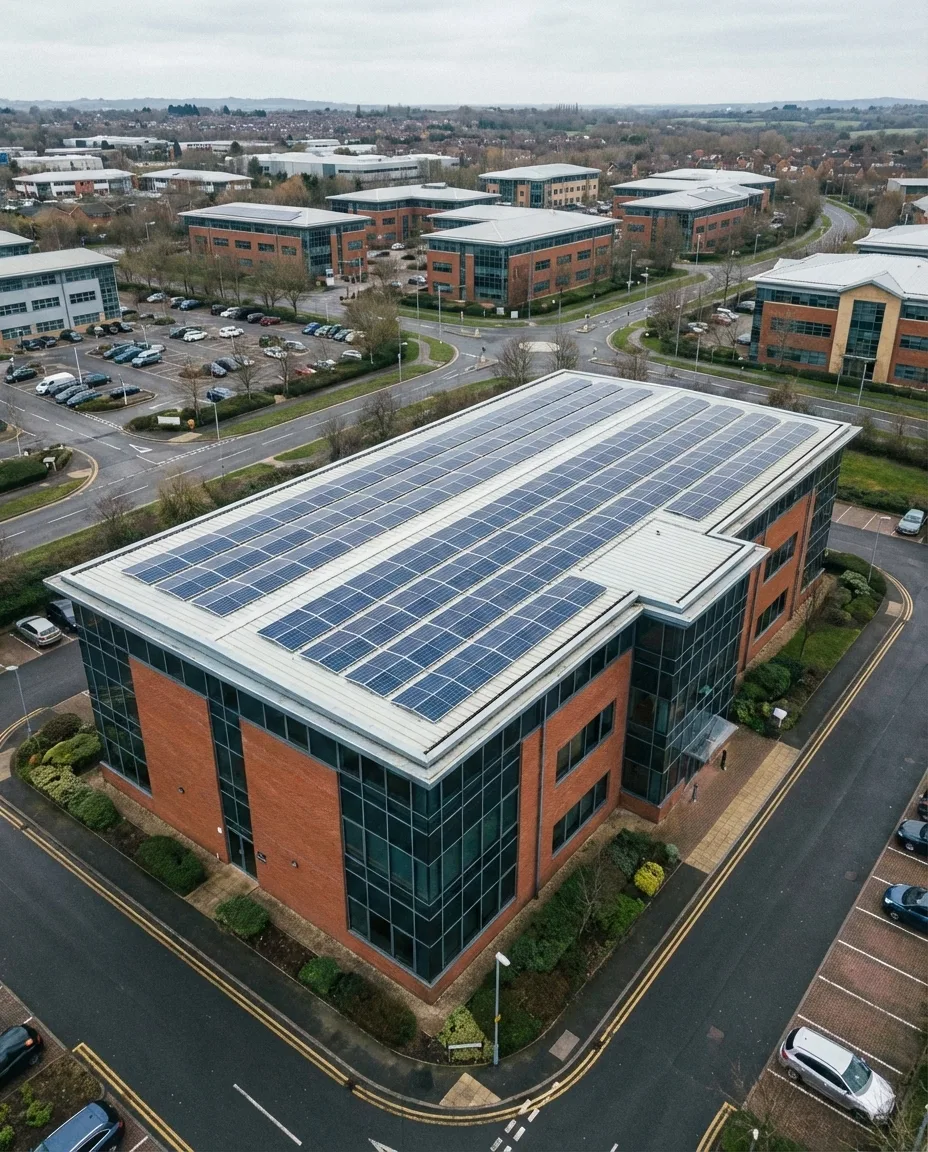
Commercial EPC Requirements to 2030: Why Rooftop Solar Should Be Part of Your Plan
An estimated 85% of UK commercial buildings currently sit below EPC B standards. With government targets pointing towards EPC C by 2028 and EPC B by 2030, property owners face a compliance challenge that will reshape the commercial property market over the next four years. The question is not whether to act, but how to act in a way that delivers compliance without unnecessary capital risk. A third-party-funded rooftop solar PPA offers a route that addresses multiple risks simultaneously.
The Risk Mitigation Case for Rooftop Solar PPAs
Traditional retrofit measures are necessary, but a rooftop solar PPA offers something different: a compliance pathway that mitigates several business risks at once.
Regulatory risk without capital exposure. Solar installations can add up to 15 EPC points, potentially moving a property from EPC E to D, or from D to C when combined with other measures. Under a PPA, a specialist funder pays to design, install, own and operate the solar array on your roof, then sells you the electricity at an agreed price for 15 to 25 years. You improve your EPC rating with no upfront investment.
Energy cost volatility. UK businesses typically pay 20p to 26p per kWh for grid electricity. A rooftop solar PPA delivers power at around 10p to 14p per kWh, with the rate either fixed or following a clear, pre-agreed index. That portion of your energy spend becomes predictable for the contract term, regardless of what happens to wholesale prices or network charges.
Sidestepping the cost-effectiveness test. MEES regulations include exemptions where improvements do not pay back within seven years. With a PPA, there is no capital outlay, so the payback calculation does not arise. You get the EPC improvement without needing to justify the investment against a seven-year threshold.
Capital deployment. For property portfolios where capital is better deployed on core acquisitions or tenant improvements, a PPA preserves balance sheet capacity while still delivering the EPC benefit. For buildings with shorter lease terms or uncertain occupancy, it removes the payback uncertainty of an owned system.
Supply chain timing. With 85% of commercial buildings below EPC B, contractor capacity will tighten as 2030 approaches. Property owners who act in the next 18 to 24 months will access competitive pricing and available installer capacity. Those who wait risk paying premium prices for rushed retrofits.
Asset value protection. Buildings with poor EPC ratings are becoming harder to let, refinance, and sell. Corporate occupiers increasingly require landlords to demonstrate measurable carbon reduction as part of ESG reporting. A building stuck at EPC D or E is not just a compliance risk; it is a competitive disadvantage in the leasing market.
The Regulatory Direction of Travel
The Minimum Energy Efficiency Standards (MEES) regulations, updated in April 2023, made it illegal to let commercial properties in England and Wales with an EPC rating below E. Government guidance indicates an interim target of EPC C by April 2027 and EPC B by 2030, though exact dates remain subject to consultation.
What matters for planning purposes is the direction of travel. Regardless of whether deadlines shift by a year, the regulatory intent is established. Non-compliance carries fines of up to 20% of rateable value (maximum £150,000), plus reputational damage and listing on the PRS Exemptions Register.
What Traditional Retrofits Cost
Industry research provides indicative ranges: moving from EPC D to C typically costs £30 to £60 per square foot; from C to B costs £50 to £75 per square foot. A direct jump from D to B runs £80 to £135 per square foot. For a 10,000 square foot office, that translates to anywhere from £300,000 to over £1 million.
These figures cover LED lighting, heating system replacement, insulation, HVAC optimisation, and glazing upgrades. The wide range reflects the reality that every building presents different challenges.
A rooftop solar PPA does not eliminate the need for other measures, but it reduces the capital burden while delivering immediate savings that can fund further improvements over time.
Landlord and Tenant Considerations
Landlords are responsible for MEES compliance and cannot automatically pass improvement costs to existing tenants unless the lease includes specific wording permitting this.
The PPA model can sidestep some of these discussions. The landlord improves the EPC rating without capital outlay, and tenants benefit from lower electricity costs without being asked to fund the installation. For multi-tenanted buildings, this simplifies the path to compliance.
Which Buildings Suit Rooftop Solar
Solar works best for buildings with flat or low-pitched roofs with minimal shading, meaningful daytime electricity consumption, and consistent occupancy patterns. Warehouses, logistics facilities, offices, retail units, and light industrial sites often fit this profile well.
A professional feasibility study assesses roof condition, structural capacity, self-consumption potential, and grid connection requirements to confirm whether solar genuinely improves both your compliance position and your commercial return.
How We Approach This at Tipio Energy
We start with your data, not with a pre-baked answer. We analyse your building's current EPC, energy consumption patterns, and roof characteristics to establish whether rooftop solar delivers the EPC improvement and financial return your business case requires.
We model a specific scenario for your site: system sizing, projected generation, self-consumption rates, and the likely impact on your EPC rating. We show you how a PPA compares to owning the system, with clear assumptions stated.
Because we are independent, we have no ties to solar funders, installers or equipment suppliers. We can benchmark different offers, flag where assumptions feel optimistic, and ensure the business case stands up to board scrutiny.
Model Your Options
The 2030 EPC requirements are coming, even if precise dates adjust. A rooftop solar PPA offers a route to compliance that mitigates regulatory, financial and operational risks while delivering ongoing cost savings.
Get a site assessment and see how solar can improve your EPC rating.
More Insights
The Consumption Baseline: Why Half-Hourly Data Should Come Before Capital
Most businesses make energy investment decisions off a monthly bill, before anyone reads the half-hourly data the meter already produces. That data shows which technology fits the site, where cost can be reduced now, and what a defensible investment case needs.
The Depot Charging Scheme: what £170m of UK funding will, and won't, pay for.
The Depot Charging Scheme has £170 million for UK fleet depots. The grant covers 70% of chargepoint and civils costs but not the grid connection, the vehicles, planning or design. Window two opens 28 October 2026.
Solar on Leased Buildings: What Landlords and Tenants Need to Get Right
Around 55% of UK commercial property by value is rented rather than owner-occupied. Solar on those buildings now works technically and commercially. What determines whether a project delivers is the lease, the funding route and the property structure underneath the panels.