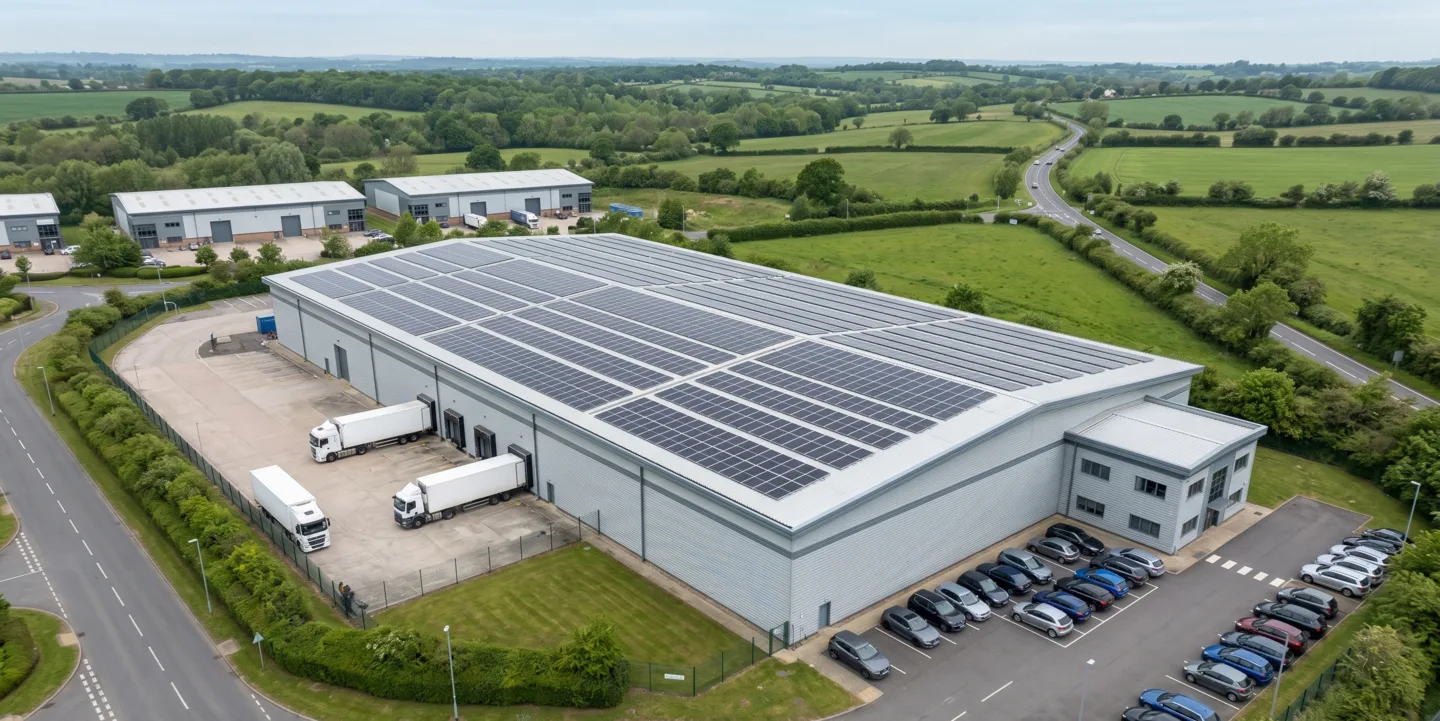
Solar on Leased Buildings: What Landlords and Tenants Need to Get Right
Around 55% of UK commercial property by value is rented rather than owner-occupied. Most of the rooftop space worth installing solar on, in other words, sits on a building where the landlord, the tenant and often a lender all have an interest in what happens to that roof. The technology works on those buildings. The economics increasingly work too. What holds projects up is not the panels. It is the property structure underneath them.
Get that structure right and rooftop solar on a leased building delivers the same outcomes as solar on a freehold one: lower energy costs, an Energy Performance Certificate (EPC) uplift, a credible carbon impact line for environmental, social and governance (ESG) reporting and an option to do all of it without putting capital on the balance sheet. Leave the lease arrangement until later in the project development, after the technical and financial work has progressed, and the surprises that emerge can derail a perfectly good business case.
Why Leased Buildings Are Different
A leased commercial roof is not the same asset as an owner-occupied roof. Someone needs explicit rights to use the roof and the airspace above it, and the answer is rarely intuitive without checking the lease. The first question is whether the roof is demised to the tenant (in property terms, whether it forms part of the leased premises) or retained by the landlord.
On a typical full repairing and insuring (FRI) lease of a single-let industrial building, the roof is usually demised to the tenant, with the tenant also taking on the repair obligation under separate covenants. On a multi-let office, retail park or shopping centre, the roof is typically retained by the landlord and maintenance is recharged through service charge. The drafting matters more than the asset class: a lease of 'the building' will usually carry the roof, walls and immediate airspace, while a lease of 'the premises only' often does not.
That distinction influences which parties are involved in the project, who negotiates with whom and where the commercial risk sits. Landlords and asset management teams know their lease portfolio well and have a good understanding of what is possible on each building. Tenants vary: a business that started a 15-year lease eight years ago may not have looked at the alterations covenant since signing, and whether the roof can be used is rarely the first question on their list.
The friction in most leased-building solar projects is not that one party has the wrong information; it is that the property terms, the operational reality and the commercial case have never been looked at together. These are routine questions, which need to be settled early, that determine whether a project moves forward or falls over.
The second difference is that leased buildings introduce a third party into every decision. An owner-occupier funding their own panels deals with one party's consents. A landlord and tenant working together deal with two. A landlord, tenant and third-party Power Purchase Agreement (PPA) developer deal with three, often four if a mortgagee or group company is in the picture. The legal architecture is well understood, though it has to be reviewed in the early project stage rather than bolted on at the end.
Where Leased Building Projects Get Stuck
Most failures cluster around three issues, none of which are about the solar panels themselves.
The roof. A solar array has a minimum 25-year design life. If the underlying roof has less than 5 to 10 years of residual life, the project either pays for a re-roof first or accepts that the panels will need to come off and go back on at some point. None of this is unworkable. It is, though, expensive enough to change the business case if discovered late. The way to avoid that is structural and roof condition surveys to discover any potential issues before the project has progressed a substantial way.
The lease. In practice, solar is generally treated as an 'improvement' for these purposes, which means consent under a qualified alterations covenant cannot be unreasonably withheld. What is not automatic is the licence to alter that turns the principle into a workable project. A landlord will reasonably require a structural survey, an approved professional team, statutory consents, an express reinstatement obligation, insurance and indemnity arrangements, preservation of any existing roof warranty and, depending on the structure, mortgagee consent. 6 to 12 weeks for that work to be completed is normal. Longer is common where the roof sits on a multi-let estate, where group company arrangements are involved or where the existing membrane warranty is at stake.
The funding and contractual structure. A PPA is a contract, not a property right. It binds the parties who sign it. It does not automatically bind a successor owner, a new tenant or a lender enforcing security. Without a registered roof lease sitting underneath it, a third-party PPA can become an awkward asset on a building sale. With the right structure, the same PPA survives ownership and tenancy changes cleanly. The legal cost of getting this right is modest. The cost of getting it wrong is typically discovered when the building is being sold or refinanced.
The Three Funding Routes
There is no single right answer. The right answer depends on the lease, the building, the parties and the appetite for capital deployment.
Landlord-funded. The landlord pays for the system, owns the asset, claims the capital allowances and uses the electricity for common parts, sells it to the tenant under a sub-supply arrangement and collects any export revenue. This route works for landlords with capital to deploy, an EPC compliance imperative, an ESG reporting need and tenants whose load profile justifies the investment. One important tax point: solar PV is classified by HMRC as a Special Rate Pool asset, so it does not qualify for Full Expensing. It does qualify for the Annual Investment Allowance (AIA), currently set at £1 million and giving 100% first-year tax relief, with a permanent 50% First-Year Allowance (FYA) available on expenditure above the cap. Industry research has consistently shown that buildings with stronger sustainability credentials achieve rental and capital value premiums, particularly in offices and increasingly in logistics.
Tenant-funded. The tenant pays for the system, claims the capital allowances against its own corporation tax and benefits directly from the lower energy cost. This route works for tenants on long, stable leases with substantial daytime electricity use and the capital to deploy. 8 to 12 years of unexpired lease term is typically the threshold. The licence to alter usually requires reinstatement at lease end, which means the tenant either removes the system, sells it to the landlord at agreed value or transfers it for a nominal sum. The tenant has the ability to install where the alterations covenant is qualified, though landlords can still refuse on reasonable grounds such as genuine structural or warranty concerns.
Third-party-funded PPA. A specialist funder pays for the system, owns it, operates it for 15 to 25 years and sells the electricity to the building occupier at a tariff that typically lands between 20% and 30% below the prevailing grid rate. Neither landlord nor tenant funds the capital. This is the most common structure on leased commercial buildings, and the most operationally complex.
Landlord-funded
Best for: Landlords with capital, EPC compliance pressure or ESG reporting needs
- Capital
- Landlord
- Asset owner
- Landlord
- Tax relief
- AIA/FYA to landlord
- Lease term needed
- Driven by landlord hold period
- Typical outcome
- Lower running costs, EPC uplift, asset value premium
- Complexity
- Moderate
Tenant-funded
Best for: Tenants on long leases with strong daytime use and capital to deploy
- Capital
- Tenant
- Asset owner
- Tenant, with reinstatement obligations
- Tax relief
- AIA/FYA to tenant
- Lease term needed
- 8 to 12 years unexpired
- Typical outcome
- Direct bill reduction, full economic upside
- Complexity
- Moderate, with end-of-term considerations
Third-party-funded PPA
Best for: Landlords or tenants who want lower energy costs without deploying capital
- Capital
- Third-party funder
- Asset owner
- Funder, via separate roof lease
- Tax relief
- Claimed by funder
- Lease term needed
- 15 to 25 years (PPA term, not lease term)
- Typical outcome
- Tariff 20% to 30% below grid, no balance sheet impact
- Complexity
- Higher, with multi-party legals
How a Third-Party PPA Sits on a Leased Building
The PPA itself is the simple part. The funder sells power at an indexed price, on standard commercial terms, in conjunction with the building's grid supply. What makes it work on a leased building is the structure that sits underneath it.
The funder needs a property right that survives ownership changes, not just a contract with the current parties. That is normally achieved through a separate roof lease granted to the funder by the building owner, structured to sit alongside any existing tenant leases without disturbing them. A building sale, a change of tenant or a refinance does not unwind the arrangement. The legal mechanics for this are well established and the contracts are mature enough that they do not need to be reinvented project by project.
The PPA term will usually run longer than any single tenant's lease, which is normally fine in practice. The solar generation is sub-metered and billed under the PPA, while the tenant retains full choice of grid supplier for imported electricity. An incoming tenant inherits a lower unit rate for the daytime electricity supplied by the array than they would have negotiated on the open market, which is usually a feature rather than a friction point during lease negotiations. Mid-lease termination, building sale and end-of-term scenarios are all covered through standard clauses: buy-out arrangements for early exits, transfer of the system to the building owner at the end of the contract (often for a nominal sum) for the long-term position and removal at the funder's expense for decommissioning. The detail of how all this is drafted matters at the contract stage. At the assessment stage, what matters is that the structures exist, work in practice and are now standard market practice on UK commercial buildings.
What Good Looks Like
A leased-building solar project that survives scrutiny usually has four features. The roof has been properly surveyed and the structure is fit for purpose, with residual life that matches the system. The lease, the licence to alter and any roof lease have been drafted to give the operator the rights they need without compromising the landlord's wider interests or the tenant's flexibility. Insurance and roof warranty positions have been signed off by the insurer and the membrane manufacturer, with a manufacturer approved installation method. The funding structure, the metering and the export rights all match how the building actually uses the electricity, and the documents reflect that physical reality.
That last point matters more than it sounds. A PPA priced on the assumption of 75% self-consumption will underperform on a building where demand is actually concentrated outside daylight hours. In those cases, on-site battery storage assessed alongside the solar can shift midday generation into evening peaks and bring the case back into range. A landlord-funded scheme that assumes the tenant will offtake the electricity, where the tenant has not signed up, ends up exporting most of its output at a much lower value. The financial model and the operational reality have to be considered in detail for a project to be viable.
How Tipio Energy Approaches This
Leased-building projects need the property and energy work to run in parallel from the start. We review the lease structure, identify whether the roof is demised, retained or partially controlled and surface any consent dependencies before they hold up the project. At the same time we analyse half-hourly meter data to model self-consumption realistically, profile the load against likely generation and confirm whether the commercial case stacks up before legal costs start running. If the financials look promising, we coordinate structural and roof condition surveys to confirm that the building can carry the system over the design life of the panels.
We consider the funding routes side by side: landlord-funded, tenant-funded and third-party-funded PPA. Each route comes with payback, internal rate of return (IRR) and net present value (NPV) under realistic self-consumption assumptions, with sensitivities on grid prices and PPA indexation. Because we have no ties to installers, funders or equipment suppliers, we can benchmark different offers, flag where assumptions feel optimistic and identify where contract terms sit outside current market practice for UK rooftop PPAs.
For PPA structures specifically, we work alongside the property lawyers to align the roof lease, the PPA, the licence to alter and any tenant offtake arrangements. The point is that one party should be looking at the project from the landlord, tenant, funder and operational perspectives at the same time. Most failed projects we see ran each workstream in isolation and discovered the conflicts too late.
Model Your Options
Solar on leased buildings has moved from edge case to standard practice. The structures work, the financing exists and the market knows how to deliver these projects. Landlords and tenants who align early on the funding route, the lease arrangement and the operational realities now have a clear path to lower energy costs, an EPC uplift and a credible carbon impact line for ESG reporting. The technology is straightforward. The legal mechanics are well established. What turns those ingredients into a delivered project is the conversation between landlord and tenant about what each party wants from the building, and the willingness to start that conversation early.
If you own or occupy a commercial building with usable roof space, the question is not whether solar is feasible. It usually is. The question is which funding route best matches your lease, your business case and your appetite for capital.
Get a site assessment and see what rooftop solar could do for your building, and your energy spend.
More Insights
The Consumption Baseline: Why Half-Hourly Data Should Come Before Capital
Most businesses make energy investment decisions off a monthly bill, before anyone reads the half-hourly data the meter already produces. That data shows which technology fits the site, where cost can be reduced now, and what a defensible investment case needs.
The Depot Charging Scheme: what £170m of UK funding will, and won't, pay for.
The Depot Charging Scheme has £170 million for UK fleet depots. The grant covers 70% of chargepoint and civils costs but not the grid connection, the vehicles, planning or design. Window two opens 28 October 2026.
Electric Fleets Need More Than Chargers. They Need an Energy Strategy.
Grid capacity is the first constraint for EV depot charging. But once you know what your grid position allows, the next question is how to design an energy system that makes fleet electrification work within those limits.