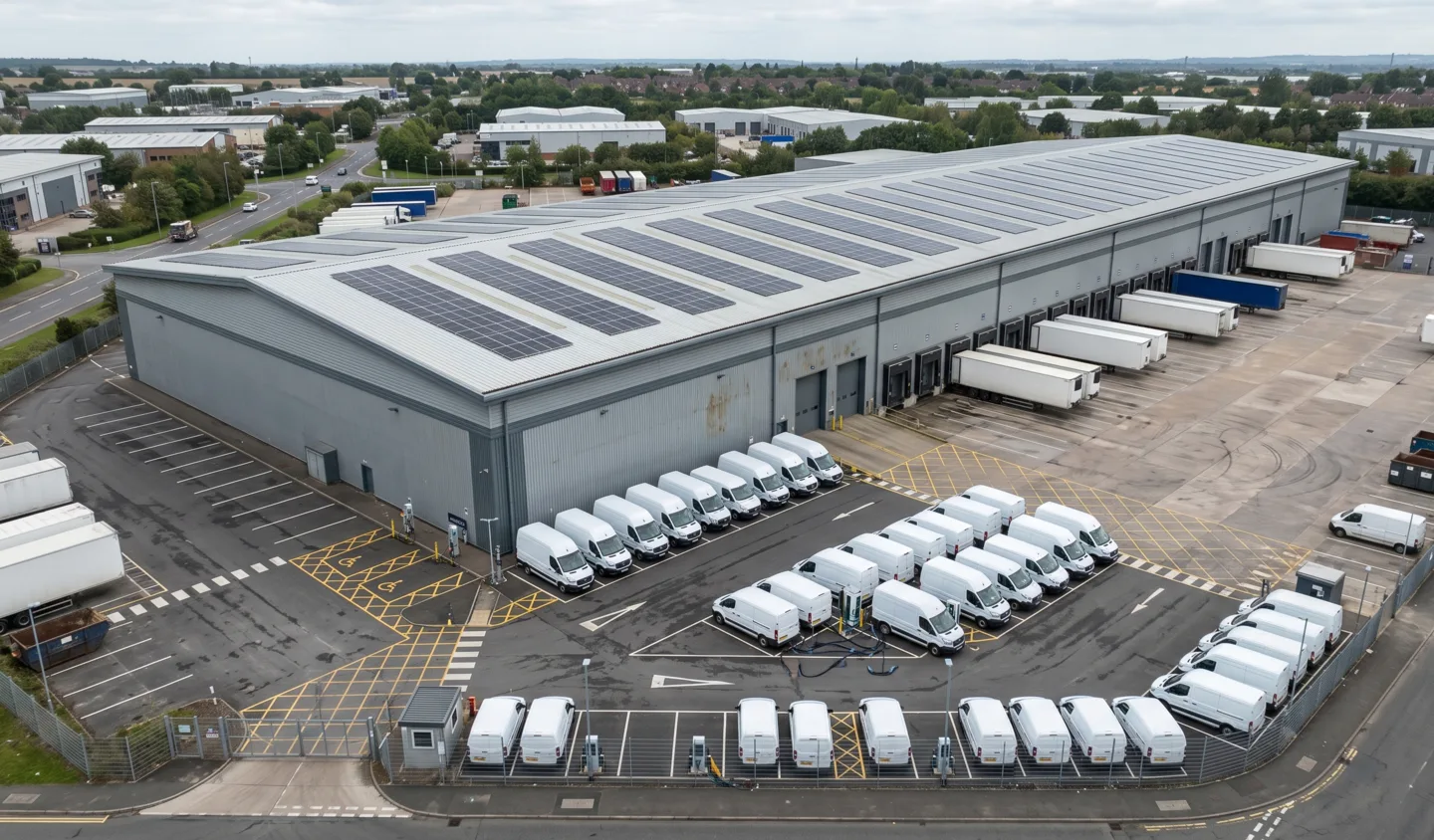
The Depot Charging Scheme: what £170m of UK funding will, and won't, pay for.
Most fleet businesses already know the Depot Charging Scheme has £170 million of grant attached. Fewer have a clear view of what the grant will actually cover, which is usually the part that decides whether a depot electrification project is possible or not. The grant covers chargepoints and civils, with conditions on solar PV and battery storage. It does not cover the grid connection, the vehicles themselves, planning costs, project management or the independent design work that needs to be in place before an application is submitted. The first grant window closes on 30 June 2026, with the second window opening on 28 October 2026.
What the grant doesn't cover matters more than the 70% headline widely promoted. The impact on the actual cost a business carries is where the preliminary feasibility work pays for itself.
What the Scheme Is
The Depot Charging Scheme (DCS) is administered by the Department for Transport (DfT). The programme is scheduled to run from April 2026 to 2030. The £170 million covers the full programme out to 2030, released in a series of application windows. The first window of £28 million opened in March 2026, with £38 million for window 2 opening on 28 October 2026, though the grant rate for this window has not yet been confirmed by DfT. Further application windows are expected through to 2030. The first two are being assessed first-come-first-served, though DfT reserves the right to move to a competition basis if a window is oversubscribed. Grant rates and exact mechanics for later windows have not yet been confirmed.
What the Grant Pays For
The first window grant rate covers 70% of eligible chargepoint and civil costs, capped at £1 million per organisation across all sites in a single application. Businesses must demonstrate they can fund the remaining 30%, evidenced at application by a letter from senior leadership or board, bank statements, loan documentation or external investment documents.
Eligible expenditure covers chargepoints of any speed or type, the civil works to install them (excavation, ducting, cable runs), the electrical components and the contractor works to energise the system. Battery storage is eligible if it is physically and operationally integrated with the chargers, supported by a signed declaration that the storage will primarily serve charging. Solar PV is eligible if it is installed solely to support the chargepoints. Solar sized to cover wider site loads sits outside the grant scope, though the wider installation can still proceed unfunded alongside the eligible portion.
There is no limit on the number of sites within a single application, but only one application per organisation per window is permitted. Grant payments are made across three delivery milestones and can take up to six weeks to clear once evidence is validated.
What the Grant Doesn't Pay For
Grid connection costs are not eligible. This single line strips out what is usually the largest item on a depot electrification budget. If a site needs new or upgraded grid connection capacity to operate the chargers, those costs sit with the business.
Applicants are required to provide evidence that they already have, or have a quoted and accepted offer for, grid capacity sufficient to cover at least 75% of the planned chargers' maximum load. Recent energy bills demonstrating contracted supply capacity are accepted as supplementary evidence where formal DNO documentation cannot reasonably be obtained. Sites without the required grid capacity need a credible plan to cover this threshold before an application can be submitted.
The Grant Funding Agreement's full list of ineligible costs also rules out planning applications, project management, reporting and administration costs, new or additional land required for the infrastructure, cosmetic works, ongoing maintenance, the electricity consumed by the chargepoints and consultancy.
Consultancy is the one to watch. Independent feasibility, engineering design and business case work sits outside the eligible project cost stack altogether. It is neither funded by the grant nor counted within the 30% match funding the applicant has to evidence. Those costs sit with the business as a separate line in the overall project budget, on top of the 30% share. Pre-Grant Funding Agreement costs of any kind are not claimable.
Who Can Apply
The DCS is open to UK-registered fleet businesses with at least one battery-electric van, HGV or coach in the fleet or on order, that have been operating in the UK for at least 12 months, and that own or lease one or more UK depots. Leases must cover a minimum of three years from the start of FY 2026/27.
The scheme is genuinely cross-sector. NHS trusts, emergency services, central government departments, local authorities, waste businesses and non-profits are all eligible, alongside businesses in logistics, distribution, manufacturing, vehicle rental, coach travel and vehicle parts and servicing.
The £1 million cap is per organisation, not per site. A multi-site business with ten depots in scope gets one £1 million cap across the whole application, not ten. Companies under common control are treated as a single enterprise and subsidiary applications must be declared. A senior leader in the company or organisation must sign off the proposal before submission.
Prepare for the Second Window Now
For businesses that have not yet started feasibility, design and contractor procurement, the first window has effectively passed.
The second window opens on 28 October 2026 with an expected £38 million available, closing on 29 January 2027. Projects can start from April 2027, with works to be completed by 31 March 2028. For most businesses now considering depot electrification, the second window is the realistic target. Feasibility, technical design, DNO engagement, contractor selection and the business case all need to be done by the autumn for a day-one application.
How Tipio Energy Approaches Depot Charging Projects
DCS grants are won by businesses who arrive at the application stage with a fully designed project: the load profile understood, grid capacity evidenced, charger and energy storage specification matched to fleet duty cycles, civils scope priced, financing for the 30% share secured and a board-level decision on the record. That work has to happen before the application can be submitted.
We start with the depot, not the chargers. Half-hourly meter data, fleet duty cycles, roof structural review and confirmed grid capacity give us the load profile and capacity envelope the project has to live within. From there we model a whole system including the chargers sized to fleet need, solar where the roof and self-consumption permit, battery storage where peak shaving or grid headroom requires it. We benchmark capital costs against current market rates, build the full project cost stack (including the items DCS does not cover) and run the business case across grant and no-grant scenarios so the project still earns its place if the funding picture changes.
We are independent of chargepoint manufacturers, installers and finance providers. The technical advice and the business case are not pre-committed to a procurement outcome. The recommendation reflects what works for the depot, not what suits a supplier.
What to Do Next
The first window is effectively closed for new prospects at this stage. The second window is the focus, and applications can be submitted from 28 October 2026. To be application-ready for day one, feasibility needs to start without further delay. The load profile, available grid capacity, design options and the 30% share financing case need to be completed by August or September.
Get a depot feasibility study to assess your site's readiness for the second window.
More Insights
The Consumption Baseline: Why Half-Hourly Data Should Come Before Capital
Most businesses make energy investment decisions off a monthly bill, before anyone reads the half-hourly data the meter already produces. That data shows which technology fits the site, where cost can be reduced now, and what a defensible investment case needs.
Solar on Leased Buildings: What Landlords and Tenants Need to Get Right
Around 55% of UK commercial property by value is rented rather than owner-occupied. Solar on those buildings now works technically and commercially. What determines whether a project delivers is the lease, the funding route and the property structure underneath the panels.
Electric Fleets Need More Than Chargers. They Need an Energy Strategy.
Grid capacity is the first constraint for EV depot charging. But once you know what your grid position allows, the next question is how to design an energy system that makes fleet electrification work within those limits.