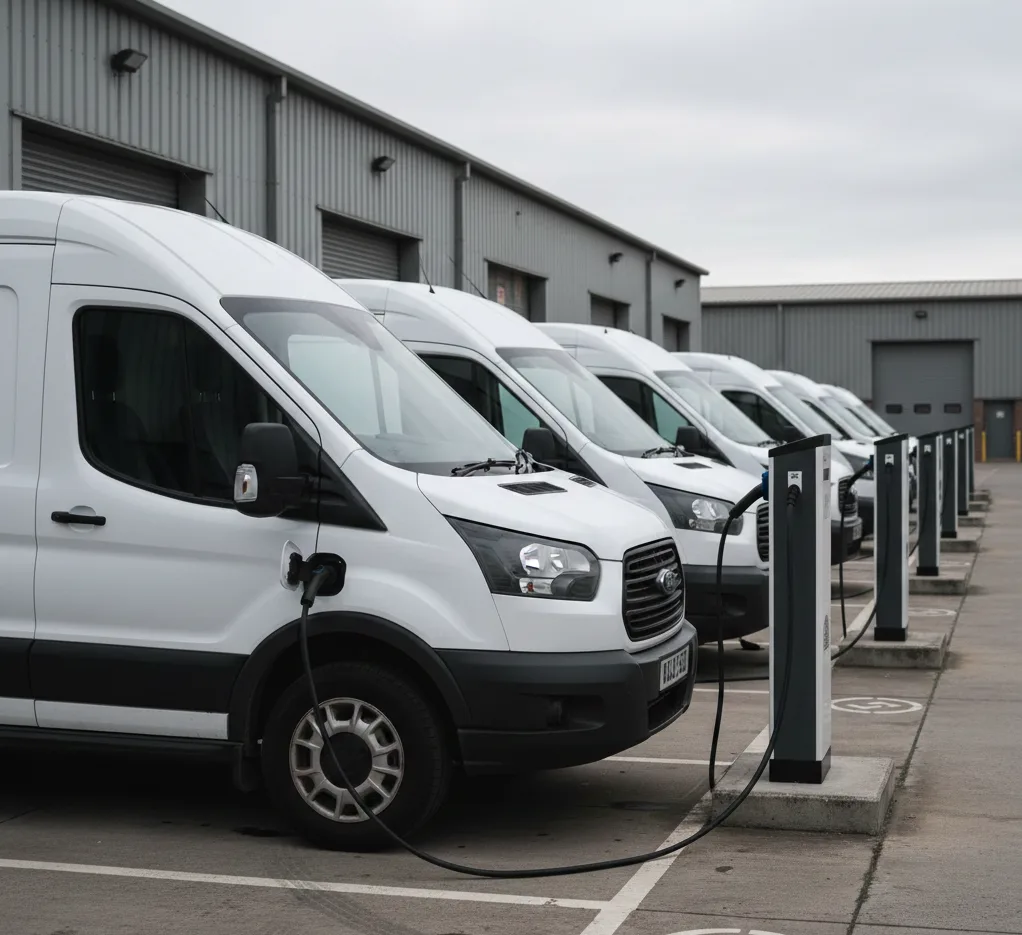
Grid Capacity Constraints: Planning Your EV Charging Infrastructure
A fleet electrification programme delayed by twelve months does more than push back your sustainability targets. It extends payback periods on vehicle investments, locks you into volatile fuel costs for another year, and hands competitive advantage to businesses that secured grid capacity earlier. For most UK businesses planning depot-level EV charging, the critical path is no longer vehicle availability. It is grid access.
The Grid Connection Challenge Facing Fleet Operators
The UK electricity grid is facing unprecedented strain. With a connection queue standing at 732 gigawatts as of September 2024, businesses wanting to install EV charging infrastructure are discovering that grid access has become the primary constraint to fleet electrification, not vehicle availability or charger technology.
This challenge is particularly acute if you operate a commercial fleet. Whilst the distribution network operators (DNOs) managed to deliver a record 9.69 gigawatts of connections during financial year 2024, the demand far exceeds capacity.
To give you a sense of what this means in practice: if you are planning to install depot charging, the timeline can stretch from three to twenty-four months depending on the scale of work required. A small fleet requiring 50 vehicles with flexible charging could expect a connection process lasting three to seven months at a cost of £200,000 to £500,000. A large firm connection might require eighteen to twenty-four months and cost between £3 million and £5 million.
These delays translate directly into business impact: delayed fleet deployment, extended payback periods on your EV investments and competitive disadvantage against early movers.
Understanding DNO Connection Timescales and Costs
Distribution Network Operators control all local electricity networks across Great Britain. When you need to install EV charging at depot level, your DNO becomes the gatekeeper determining both the timeline and the financial cost of your project.
The process begins with notification. For straightforward installations where your charging demand sits below 30 percent of your site's existing capacity, the process is relatively simple: your installer notifies the DNO, which typically responds within three to seven days, often within 24 to 48 hours. This can be completed within weeks.
However, when your charging requirements exceed available capacity, a network upgrade becomes necessary. These are called G99 applications (as opposed to the simpler G98 notifications). A G99 assessment takes thirty to sixty working days, with complex scenarios potentially extending two to eight weeks or longer depending on DNO backlogs and the severity of network constraints.
The delays are compounded at national level: the government's reform programme aims to reduce average waiting times from eighteen months to six months by 2027, which signals just how problematic current timescales have become.
The cost structure changed significantly from 1 April 2023. Under reformed connection charging, demand customers connecting EV charging infrastructure are no longer liable for the costs of broader distribution network reinforcement, only for equipment solely for their own use. That said, if your site requires substantial electrical upgrades, new substations, reinforced cabling or transformer enhancements, costs remain substantial.
Three Practical Strategies to Work Within Grid Constraints
Rather than accepting extended timelines as inevitable, there are three complementary approaches that both reduce costs and accelerate deployment. It is worth understanding each in turn.
Smart Charging and Dynamic Load Balancing
Smart charging technology represents the most cost-effective mitigation. Dynamic load balancing monitors energy flow to each charger in real-time and adjusts power distribution based on actual demand. If five 22kW chargers are installed, but your site's available capacity would normally support only three running simultaneously, dynamic load balancing allows all five to operate, each receiving its proportional share of available power.
This approach prevents overload, eliminates costly infrastructure failures and critically, removes the need for expensive grid upgrades. Rather than requiring a new 110kW power supply to run five 22kW chargers, dynamic load balancing can enable that through a shared, smaller supply managed intelligently. Smart scheduling further optimises costs by automatically charging vehicles during off-peak hours when electricity rates are significantly lower. SME businesses on standard tariffs frequently see meaningful cost reductions through intelligent scheduling alone.
Battery Energy Storage Systems
Battery energy storage systems (BESS) function as a buffer between your charging infrastructure and the grid. Stored energy discharges during peak charging periods, substantially reducing the maximum power drawn from the grid at any moment.
The financial impact is significant. BESS can reduce peak demand by up to 67 per cent in depot scenarios, enabling energy cost reductions of up to 30 per cent through peak shaving and off-peak charging optimisation. In cases where smart charging strategies incorporate BESS, electricity costs can fall by as much as 65 per cent.
Beyond cost savings, BESS defers or eliminates up to 40 percent of grid infrastructure investments that would otherwise be required.
For a business facing a two-year grid reinforcement timeline, integrating battery storage can accelerate deployment by months whilst simultaneously reducing operational energy costs. That is a compelling dual benefit.
On-Site Solar Generation
On-site renewable generation eliminates dependency on grid electricity altogether for a portion of your charging needs. Organisations across the UK have successfully deployed solar capacity at depot locations, with examples including installations ranging from 50kWp to over 100kWp of capacity, optimising self-consumption of solar energy for EV charging through integrated management systems.
Where space permits, solar car ports with integrated EV charging have proven particularly effective. Multi-charger installations with dedicated solar generation have demonstrated the ability to deliver substantial portions of annual electricity needs from on-site generation, completely avoiding or significantly deferring the need for additional grid connections.
The financial and operational benefits are compelling. Solar generation reduces exposure to grid electricity price volatility, provides a hedge against future energy cost increases and in many cases enables you to meet sustainability commitments independently of grid decarbonisation timelines. Battery storage systems paired with solar generation further optimise this benefit by capturing surplus generation during daylight hours for use during peak charging periods.
A Practical Framework: How Tipio Energy Guides Your EV Charging Strategy
The single most important decision for successful fleet electrification is timing. By engaging early with your DNO, before finalising your EV strategy, you can design charging infrastructure around actual grid constraints rather than discovering bottlenecks after committing to vehicle deployment timelines. This is where Tipio Energy's expertise makes a material difference.
Tipio Energy follows a structured five-step framework to assess your site and create a cost-effective, viable charging infrastructure:
Step 1: Site Electrical Capacity Audit
We establish your current authorised capacity and identify available headroom for charging demand. This initial assessment determines whether your charging requirements fall below the 30 per cent threshold of total site demand, which could allow a simple DNO notification rather than a full application, saving months and costs.
Step 2: DNO Pre-Engagement Assessment
Rather than navigating DNO connection enquiries alone, we prepare your submission with the essential information: operating centre location, charger specifications and power requirements, vehicle types and anticipated charging patterns and your existing load profiles. We coordinate directly with your DNO to identify constraints and opportunities at the earliest stage, typically scheduling assessments within two to three weeks.
Step 3: Connection Options Analysis
If your DNO identifies network constraints, we evaluate flexible or curtailable connection options on your behalf. These arrangements allow you to accept reduced capacity during peak hours in exchange for faster, cheaper connections. For many businesses, this middle ground between full reinforcement costs and operational limitations proves optimal. We model the financial and operational trade-offs specific to your fleet profile.
Step 4: Infrastructure and Technology Design
Only once we fully understand your available capacity, we specify chargers, load management systems and whether solar or battery storage add business value. A 22kW charger may prove unnecessary if dynamic load balancing enables effective charging through 11kW or 7kW EV chargers. Our design optimises both capital expenditure and operational costs.
Step 5: Realistic Timeline and Contingency Planning
We establish project timelines accounting for real-world DNO processing. Standard connections in areas with available capacity typically require three to six months. Where modest network reinforcement is required, plan for six to twelve months. We build these realities into your deployment schedule from the outset, preventing the costly surprises that plague businesses managing this process independently.
The Advantage of Decisive Action
Grid congestion is not improving imminently. The government's connection reform programme, whilst welcome, will take years to fully impact local distribution networks. Meanwhile, demand for EV charging infrastructure continues accelerating.
Businesses that engage now with their DNOs, deploy smart charging technology and integrate battery storage or renewable generation will deploy fleets months, sometimes years, ahead of those who discover grid constraints too late.
Your grid connection is not an afterthought. It is the foundation of a successful EV fleet transition. Early planning, pragmatic technology choices and strategic engagement with your DNO transform a constraint into an opportunity.
Assess Your Site
Tipio Energy can help you understand what your site's grid position allows, design charging infrastructure that works within those constraints and coordinate DNO engagement so you are not left waiting. We will give you a clear view of the costs, timelines and trade-offs.
Get an assessment and see how to accelerate your fleet electrification.
More Insights
The Consumption Baseline: Why Half-Hourly Data Should Come Before Capital
Most businesses make energy investment decisions off a monthly bill, before anyone reads the half-hourly data the meter already produces. That data shows which technology fits the site, where cost can be reduced now, and what a defensible investment case needs.
The Depot Charging Scheme: what £170m of UK funding will, and won't, pay for.
The Depot Charging Scheme has £170 million for UK fleet depots. The grant covers 70% of chargepoint and civils costs but not the grid connection, the vehicles, planning or design. Window two opens 28 October 2026.
Solar on Leased Buildings: What Landlords and Tenants Need to Get Right
Around 55% of UK commercial property by value is rented rather than owner-occupied. Solar on those buildings now works technically and commercially. What determines whether a project delivers is the lease, the funding route and the property structure underneath the panels.