Why Your Business Is Paying Too Much for Electricity in 2026
UK businesses typically pay 20p to 26p per kWh for electricity, with smaller operations often quoted closer to 26p to 30p. A third-party-funded rooftop solar Power Purchase Agreement delivers power at around 10p to 14p per kWh, giving a modelled reduction in the region of 30% to 50% on the solar portion of your energy spend. For a site using 50,000kWh a year, that points to projected savings of roughly £6,000 to £7,000 annually before you factor in future grid price rises.
The Problem: Volatile Energy Spend
Most finance directors now treat energy as a strategic cost line, not just an overhead. The issue is that grid tariffs move in ways you cannot control and are difficult to predict with confidence.
Recent contracts have seen double-digit percentage swings between renewal cycles, and that plays havoc with budgeting and long-term planning. Even when wholesale prices ease, non-energy charges and policy costs can keep your delivered rate stubbornly high.
Then there is the simple fact that you have limited time to track every market update or negotiation window. You are trying to run a business, not trade power.
The Opportunity: What a Rooftop PPA Offers
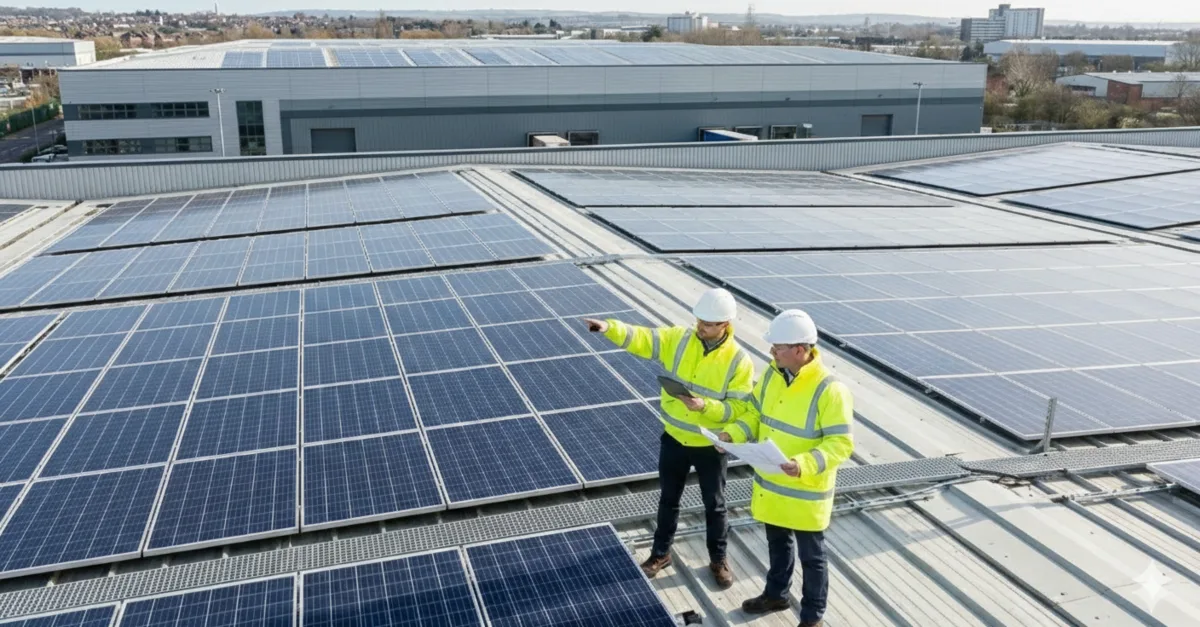
A rooftop PPA is a straightforward idea. A specialist funder pays to design, install, own and operate a solar array on your roof, then sells you the electricity it generates at an agreed price for an agreed term.
In the UK SME market in 2026, that price typically sits well below your grid rate, often in the 10p to 14p per kWh range, with the rate following a clear, pre-agreed index. The result is a chunk of your daytime consumption being supplied at a known cost for 15 to 25 years, so you reduce your exposure to whatever happens in the commodity and non-commodity elements of your grid tariff.
To give some context, if your current blended grid rate is 27p per kWh and your rooftop PPA is set at 12p, every kWh you consume from the roof costs you less than half what you would have paid to your supplier. Over time, as grid charges continue to fluctuate, that price certainty is where the rooftop PPA quietly earns its keep.
How a Third-Party-Funded Rooftop Solar PPA Works
The basic mechanics are simple from your side.
First, your site is assessed. A specialist models your roof area, structural constraints and your half-hourly consumption data to size a system that matches your daytime load as closely as possible. The aim is high self-consumption, because that is where the business case is strongest.
If the numbers stack up, you enter into a Power Purchase Agreement that sets out three things in plain terms: the price you will pay per kWh for the solar power, the contract length (typically 15 to 25 years) and the responsibilities around operation and maintenance. The PPA provider then funds and manages the project, from design through to installation and ongoing performance monitoring.
You keep buying electricity from your existing supplier for any demand the solar cannot cover, and for evenings and nights. The solar power you consume on site is simply billed by the PPA provider at the agreed tariff, usually via a straightforward monthly invoice.
When the system produces more than you are using at a given moment, the surplus is exported to the grid. The export value stays with the PPA provider, and that is part of how they recover their investment and cover their risk over the term. That arrangement is already factored into the price you pay per kWh, so you are not missing out on an extra revenue line. You are swapping it for a lower, more predictable energy cost.
Who a Rooftop PPA Tends to Suit
Rooftop PPAs have historically been accessible to very large corporations with big, single-ownership sites. That is changing. The UK corporate PPA market more than doubled between 2023 and 2024, adding over 2GW of new capacity, which has encouraged more funders to back smaller, standardised contracts for SMEs.
In practice, a rooftop PPA tends to work well for sites that have three characteristics. First, meaningful daytime electricity demand on most working days, for example warehouses, manufacturers, cold stores, distribution centres or larger retail and office sites. Second, a roof in reasonable condition with enough clear area to mount panels safely. Third, a business that values long-term cost control but would rather use its own capital for core operations, acquisitions or other priorities.
If you have that profile, the capital-free nature of a PPA is often what unlocks the opportunity. Owned systems can deliver payback in around four to seven years for typical manufacturing or warehouse sites, with annual returns in the region of 10% to 20%, but they require upfront spend and a willingness to own the asset and its performance. With a PPA, you leave that capex and technical performance risk with the funder while still benefiting from lower, more stable unit costs.
Why PPAs Now Work for SMEs
The regulatory and market picture supports this. The UK passed around 18GW of installed solar by early 2025, with commercial rooftops taking a growing share, and policy is now explicitly expecting more commercial rooftop deployment to hit the 2030 solar targets. That direction of travel gives long-term confidence to the funders who sit behind PPA offers.
Standardisation has improved too. Contracts that once took months of negotiation for a single corporate site have evolved into templates that can be adapted for mid-sized warehouses and multi-site SMEs without starting from scratch each time. For you, that shows up as clearer terms, simpler risk allocation and faster paths from first conversation to installation, often in the six to nine month range from initial feasibility to commissioning for a typical rooftop project.
Installation itself is relatively swift. For many SME sites, physical works on the roof take around eight to 12 weeks once designs, approvals and grid agreements are in place. A well-run project will plan works around your operations, so the impact on day-to-day activity is limited.
PPAs Versus Owning the System
It is worth being clear about the trade-offs.
If you buy the system outright, you fund the capex, own the equipment and can claim tax reliefs such as the Annual Investment Allowance (AIA), which currently allows up to £1 million of qualifying plant and machinery expenditure to be deducted from taxable profits each year. You also keep any export revenue. In return, you take on performance, maintenance and long-term asset risk, as well as tying up capital that might have been used elsewhere.
With a PPA, you do not own the system, so you cannot claim AIA on the solar equipment. Your benefit is purely the price you pay for the on-site electricity, and the stability that brings over 10 to 25 years. For many SMEs, that is precisely the point. They want the economic benefit of rooftop solar without turning themselves into mini utilities or taking on a queue of technical decisions.
In both models, the underlying economics are helped by the same reality: retail business electricity prices remain significantly higher than the levelised cost of well-sited rooftop solar in 2026. A PPA simply packages that spread into a structure that removes the need for upfront capital and specialist technical knowledge.
What About Risk?
You will rightly ask where the catch is. A well-structured rooftop PPA should address the main commercial concerns up front: who is responsible for the roof, what happens if you move or refit, how performance is monitored and how the PPA price behaves over time.
The key is to put the PPA in the context of your wider energy strategy. You are not betting the company on a single project. You are shifting a portion of your future energy spend from uncertain renewal pricing to a known price path, on a technology with predictable output once installed. The residual risks are then managed through contract terms, insurance and proper technical design.
From our experience, the most common source of friction is not technical at all. It is internal alignment. Finance, operations and property teams need a shared view of what success looks like and how the PPA sits alongside other plans for the site.
How We Approach This at Tipio Energy
We start with your data, not with a pre-baked answer. We analyse your half-hourly consumption, your tariff history and your sites to see where rooftop solar PPAs genuinely earn their keep and where they do not.
We then model a specific rooftop PPA scenario for your site, including system sizing, projected generation and how much of that power you are likely to use on site across the year. We show you the projected savings, the PPA price path over time and how much of your energy spend would be on a more predictable footing if you move ahead.
Because we are independent, we are not tied to a single funder or installer. That means we can benchmark different structures and offers, sense-check the assumptions in the background and flag where terms feel out of line with the current market for SME rooftop PPAs.
We present the findings in a way that works for your board or investment committee: clear numbers, clear risks and a clear business case you can interrogate.
Model Your Options
If you are looking at energy costs for the next three to five years and you have usable roof space, a rooftop PPA is now a realistic option for many UK SMEs, not just large corporations. It gives you a route to more predictable, lower daytime electricity costs without tying up capital, and it can sit comfortably alongside future efficiency measures or asset upgrades.
Tipio Energy can help you find out whether it makes sense for your sites. We will model your options, show how a PPA compares to owning the system and give you a straight view of the upside and the trade-offs.
Get a site assessment and see what a rooftop PPA could do for your energy spend.
More Insights
The Consumption Baseline: Why Half-Hourly Data Should Come Before Capital
Most businesses make energy investment decisions off a monthly bill, before anyone reads the half-hourly data the meter already produces. That data shows which technology fits the site, where cost can be reduced now, and what a defensible investment case needs.
The Depot Charging Scheme: what £170m of UK funding will, and won't, pay for.
The Depot Charging Scheme has £170 million for UK fleet depots. The grant covers 70% of chargepoint and civils costs but not the grid connection, the vehicles, planning or design. Window two opens 28 October 2026.
Solar on Leased Buildings: What Landlords and Tenants Need to Get Right
Around 55% of UK commercial property by value is rented rather than owner-occupied. Solar on those buildings now works technically and commercially. What determines whether a project delivers is the lease, the funding route and the property structure underneath the panels.